Showing posts with label alternative history. Show all posts

Monday, 24 October 2022

Meet the Author: Harry Turtledove, author of Three Miles Down


 Dr Harry Norman Turtledove is an American novelist, who has produced a sizeable number of works in several genres including alternate history, historical fiction, fantasy and science fiction. He attended UCLA, where he received a Ph.D. in Byzantine history in 1977 - and has been dubbed “The Master of Alternate History”. He chats to Brent A. Harris about his new book - and much more. 


Hello! Recently, I was given the opportunity to interview author Harry Turtledove to discuss his latest book Three Miles Down. Now, if you haven’t read this book, go ahead and read it as we discuss potential spoilers. You can get Three Miles Down here but pop into your local brick and mortar indie bookstore instead if possible.

Now that you’ve read the book (you have, haven’t you?) I really want to ask Harry some tough, difficult, um, introspective questions, like: What would your cats say if it they could talk?

Feed me! Feed me more! Give me the really good stuff, with the shrimp! Play with me! Adore me!” What do cats ever say?


Okay, so now that we got you warmed up, let’s talk about your book Three Miles Down. For the people who didn’t do the reading (yes, you back there, I see you) it’s a novel of first contact during the politically charged Watergate scandal. Now all this happens under the real-world guise of the too-strange-to-be-true Project Azorian where the CIA cleverly retrieves a chunk of a Soviet submarine from the depths of the Pacific. But in Turtledove’s book, that’s all just a cover for … wait for it… …Aliens.

How did the idea for this book First Contact you?

I had watched a documentary about Project Azorian on one of the channels you turn on when you’re awake at 3 in the morning and are looking for something to stare at. So I sorta knew what it was. Then I saw an ad for a book about it, and it occurred to me to wonder, What if the Soviet sub didn’t sink by itself? What if it had some help...from aliens? So I bought the book, and it led me to some more books, and I started writing at about the same time as the COVID pandemic started shutting down the world.


What can you tell us about Project Azorian without running afoul of any alphabet agencies?

The CIA spent a moon landing’s worth of money--several hundred million dollars’ worth--to build the Hughes Glomar Explorer and raise the Soviet sub K-129 from three miles down in the Pacific to see what it could learn about Russian nuclear missiles and codes. One claw on the grabber broke, though, so they only raised part of the sub--and not the most important part, either. A hell of a lot of money mostly down the drain.


Okay, you’ve tried not to be topical in your fictional worlds, but really: Cold War tensions and the looming threat of MAD, an unhinged President that threatens to unravel the Republic, and a rapid advancement of our understanding of our place among the stars … are we talking about your book or current events? Was there an obvious parallel here that you wished to explore?

You can’t not notice the parallels. I referred to them, sure, but I also tried not to beat people over the head with them. To quote Theodore Sturgeon, “Thou shalt not sell thy birthright for a pot of message.” Readers are smart. You don’t have to send up a bunch of flares to show them where you’re going.


Three Miles Down reads as a mash-up of Clancy meets SF. But most of all, it reads like a thrill ride down memory lane. Was there anything autobiographical to Jerry’s grad school experiences?

Does the Pope poop in the woods? Does a bear wear a funny hat?


Three Miles Down is heavily steeped in the popular culture of its time and only hints at war. Do you see a shift within a-h away from stories of warfare and toward social and cultural topics? If so, why?

I’m steeped in the pop culture of the 1970s. I’m a year younger than my protagonist. War is always interesting because, like love, it shows character under stress. Wars are also easy changepoints for history. There are other ways to change things, though--aliens at the bottom of the ocean, for instance.


You certainly don’t shy away from puns. In fact, they appear quite deliberate as if you meant to write them and then somehow slipped them past your editor. If there is indeed an afterlife, what do you believe your pun-ishment will be?

My editor for this book was Patrick Nielsen Hayden. He has been known to pun himself. Oh, just a little. I don’t think there’s an afterlife, exactly. I think there’s reincarnation. I aim to come back as a boutonnièrre.


This isn’t your first alternate history story that deals with aliens. Why are aliens a recurring motif in your work?

Aliens are a recurring theme in most sf writers’ work. They let you play with the Other, and with the Other’s effects on people, which is what I was especially interested in here.


Have Spacesuit Will Travel plays an important part in the plot. But why this story of all the classics?

It’s one of Heinlein’s two best juveniles, imo--Citizen of the Galaxy is the other. It’s endlessly rereadable. And it involves humans unexpectedly meeting aliens. How could I resist? I didn’t even try.


Why, of all the SF writers in the 70s, did you pluck Pournelle for duty on the Glomar Explorer? Are there any other notables or Easter Eggs that we might have missed?

I knew Jerry for 40 years. Our politics didn’t mesh, but we always got on pretty well. He lived in Los Angeles. He was a conservative and an aereospace guy, the kind of sf writer the CIA might smile on. He seemed a reasonable choice


Three Miles Down is alternate history. However, we only see why history has changed, but we don’t learn how it changes. Is learning how things change an important part of alternate history? What is alternate history to you?

I didn’t really conceive of Three Miles Down as a-h. I thought of it as an sf novel that was necessarily set in the past. Alternate history to me is what happens when you get somebody who was rigorously trained as a historian and always wanted to write science fiction.


If First Contact were to happen right now, what do you think would happen, given the history of first contact between the Old and New Worlds?

I’ve written a novelette about this. It’s called “Vilcabamba,” and is available on the tor.com website. It’s pretty grim.


Your latest author photo is … unusual. How did that come about and is there a smirk hiding under that mask?

Three Miles Down was written as COVID was spreading around the world. One of my daughters took the pic. I thought it would be appropriate and amusing as a jacket photo.


What should the writers and gatekeepers of alternate history do to encourage diversity within the genre?

History is a question of perspective. The world does not look the way it does to a white male Christian from the USA if you’re a Nigerian Muslim woman. The more angles you can examine something from, the better off you are. We need those different perspectives.


What can you tell us about your forthcoming novel Wages of Sin?

Wages of Sin is set in 1850s England in a world where HIV got loose in the early 1500s. Given sixteenth-century hygiene standards--and given the simultaneous emergence of syphilis, which is real good at creating genital lesions--it would spread rapidly and be altogether untreatable. People would need a little while to figuire out what was going on, of course, but when they did, massive social changes would result. Since those necessary social changes fly in the face of humanity’s permanent impulse to get it on now and worry about consequences later, you have some obvious tensions. I’ve written about them.


Thanks, Harry! And everyone, if you want to connect with him, head over to his Twitter account at @HNTurtledove where he regularly posts pictures of his owners cats!\


Three Miles Down is available on Amazon at https://www.amazon.com/dp/1250829739/ 


• Interviewer Brent A. Harris is a twice nominated Sidewise Award author of alternate history and an editor behind the acclaimed Tales From Alternate Earths series. He writes stories and scripts about dinosaurs, steampunk Dickens, and smart homes that try to kill you. While he currently lives abroad one day he’ll return home to the sands of California to claim the Iron Throne.


Thursday, 1 September 2022

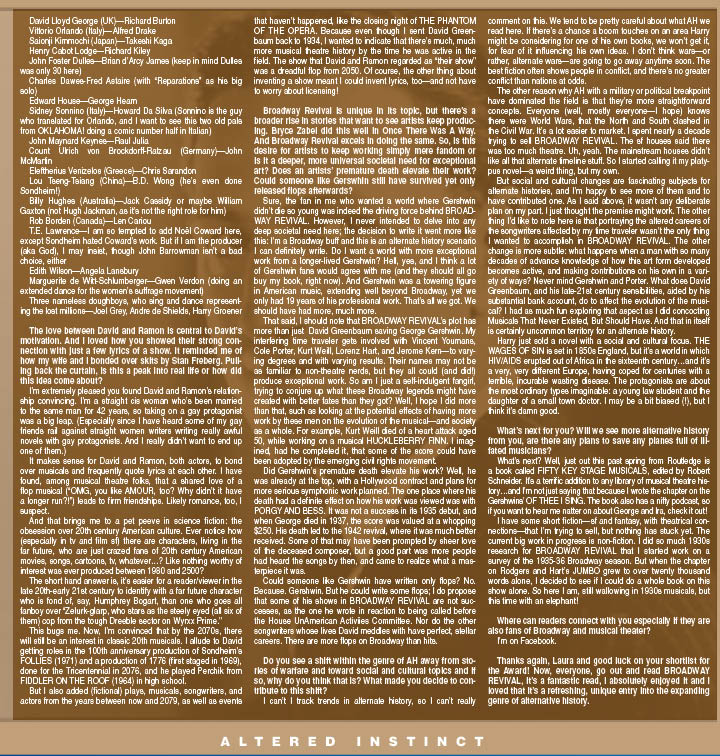
Meet the Author: Laura Frankos, author of Broadway Revival


Laura Frankos is the author of Broadway Revival, currently shortlisted for the Sidewise Award in Alternate History which will be presented at Worldcon Chicago this weekend.


For those who are not familiar with either your novel Broadway Revival or the Sidewise Award for alternate history, could you tell our readers a bit about your book and what it means to you to be nominated for this award?


In BROADWAY REVIVAL, David Greenbaum is an actor-songwriter whose husband has just died from the latest designer drug addiction in 2079.  David pulls himself out of despair with an outrageous plan. He couldn’t save Ramon, but he might make a difference in other lives cut short. He hijacks his brother Nate’s time machine, the SlingShot, and jumps to 1934 to save George Gershwin from the brain tumor that killed him at age thirty-eight.

That’s just the start of David’s “Broadway Revival Project.” Gershwin wasn’t the only one who died too young. David has a suitcase of modern medicine and the advance knowledge of nearly 150 years of musical theatre history. He’s determined to make the Golden Age of Broadway shine even more brightly.

But David’s actions are causing changes to the timeline that have the Rippers—the international time travel research consortium—very worried. So Nate climbs in the SlingShot, determined to track down his brother in 1930s New York.

I’m incredibly honored that BROADWAY REVIVAL is a finalist for the 2021 Sidewise Award. Alternate history is kind of a big deal in our house; my husband, Harry Turtledove, has written a lot in that sub-genre and is a multiple Sidewise winner. But I would be the first to admit that BROADWAY REVIVAL is a weird kind of alternate history, so I’m extremely chuffed by this recognition.


One of the things that worried me about starting your book was that I’m completely ignorant of Broadway, especially of the 1930s. Yet, the prose is breezy, easy to read, and every character, historical and fictional, leaps to life. How did you approach writing these historical figures and what to you think makes them approachable even to people like me who may not know the era?


First of all, thanks so much for that. I figured I could hook the theatre geeks, but whenever somebody with little background in Broadway likes it—wow, that makes my day! I’m an historian by training and a Broadway nut my whole life, so I already was very familiar with the personalities of this era. That said, I did spend years doing homework, especially trying to get into the complex head of Lorenz Hart. The way I approached portraying these figures was first and foremost as people: they have relationships, eat and drink, argue, brag, discuss sports, go to parties. That’s something any reader can relate to, even if they’re doing all that in the 1930s. It’s also true most readers won’t have written musicals themselves, but you don’t need to have done that to be familiar with pressing deadlines, changing work circumstances, and the problems of collaborations. 

As for the specific characters like the Gershwin brothers, Cole Porter, Kurt Weill, et alia, my ace in the hole was my protagonist, David Greenbaum. As a newcomer to New York (albeit one with secret, vast historical knowledge), he’s getting to know these folks and this era just as the reader is. He can mention his plans in a way that gives the reader background on these Broadway legends and his new home—hopefully, without too much exposition.


What inspired your passion of musical theater? What has been your favorite show on or off Broadway?


My mom loved musicals. So I grew up on cast albums, listening to her playing sheet music on the piano, and watching movie musicals on tv. My favorite show is SWEENEY TODD, THE DEMON BARBER OF FLEET STREET, because I think it’s about as close to perfection as a musical can get.


Let’s talk about hats. It irks me when hats are ignored in historical eras. So, I loved your character’s reaction to seeing everyone sporting headwear. How did you breathe life into your Broadway of the 30s and beyond?

“Does anyone still wear a hat?” is a famous line from Sondheim’s 1970 musical, COMPANY. I agree with you about being irked by historical novels and films that get period wardrobe wrong. Again, I’m helped by my time traveler as the outsider—and one who, as an actor, was accustomed to costumes. Practically the first thing he notices, arriving in 1934, is that everyone looks….like they’re wearing costumes. Hats everywhere, and clothes made with far more natural fibers than he’s used to in 2079. It takes effort to adjust to that.

I wanted the reader to feel a part of that past too, so I tried very hard to concentrate on the details of daily life. This included all those restaurants. That was critical not just for the awesome descriptions of the meals (go to the NYPL online digital historical menu collection! Such a fantastic site!), but because Broadway creatives did a lot of their work at the bars and restaurants close to the theatres. And David’s first job is playing piano at a restaurant in Greenwich Village, a real place with a storied history that I cheerfully pillaged for my fictional purposes. David does complain about some aspects of his new life: the coffee’s terrible, there are no delicious microbrews, not so much good ethnic food.

But it’s not the different clothing and food that really throw him. It’s the sudden loss of the wealth of information available in the late 21st century. He goes from instant access to everything to relying on radio, newsreels, and newspapers. He brings the equivalent of a 2079 iPad with him, and has to restrain himself from checking it all the time. I think even if people today were plopped back in, say, 1980, they’d go bonkers at losing the Internet. I suspect it would be worse for someone in 2079 going back to an even less technologically advanced era.

It’s also so much fun researching historical details! Like Bronx cocktails. I have those show up in the first chapter, where David is drinking them because they were Ramon’s favorite drink. Ramon discovered them while researching a Jerome Kern musical, which I thought was a good, single fact that tells reader not only a lot about Ramon, but also how much David is missing him. Once David jumps to 1934, he drinks Bronxes all the time—they were one of the most popular drinks of the decade, but eventually were supplanted by martinis, a close cousin.

For a number of years, while I was writing and trying to sell BROADWAY REVIVAL, I ordered Bronx cocktails in restaurants. This freaked out the waiters, who’d never heard of them, and had to google them. This is dedicated research, people. I do all my own homework!


Broadway in 1934


There are many cameos and namedrops of historical figures (and at least one by a fictional one). With minor spoilers, a certain ballplayer from Harry’s House of David {editor’s note: House of Daniel, sorry} slides in and steals a scene. How did that come about, and what was your favorite cameo or name drop to write?

Oh, there are Easter eggs galore, though many will only be spotted by theatre nerds. When David’s brother Nate is searching for him, there are about a half dozen historical figures lurking in that chapter, especially at the restaurant. And they’re all people who logically could have been in Greenwich Village in 1934, so I plead simultaneous plausibility and fun.

When I was writing BROADWAY REVIVAL, Harry was working on THE HOUSE OF DANIEL (**not House of David—that’s the real team). {Editor’s note: this is a hazard when reading alternate history}. That novel is set in a 1930s America, except with magic and vampires and zombies, along with semipro baseball. Now, I ask you: what are the odds, in a two-writer household, that BOTH writers would be working on material involving alternate 1930s Colorado at the same time? My protagonist had reasons to go to Colorado Springs; Harry’s baseball team played in a tournament in Denver…adapted from a real one in our timeline. So I asked him if I could have his protagonist briefly cross paths with mine (I had him make a stop in Denver). If you look closely at THE HOUSE OF DANIEL, there’s an unnamed variant of David Greenbaum in the Denver chapter. He’s the guy juggling oranges. My David spills a bag of oranges. This falls under Weird Stuff Writers Do To Amuse Themselves.

That crossover tickles me no end, but my favorite historical cameo has to be the couple of scenes with Lotte Lenya, Kurt Weill’s wife. The only thing more fun than putting words in the incomparable Lenya’s mouth was writing dialogue for Oscar Levant. I had to restrain myself from going overboard with both of them; they were so much fun to write.


If you could pull together anyone from theater history to write and perform a show, which ones would you cherry-pick and what sort of show do you think they would put on?

Ooh, dream production time! That’s easy. There was a report that Sondheim was considering a musical based on the Paris Peace Conference and the Treaty of Versailles, but nothing came of it. I want this so much, I’m practically drooling over the possibilities, especially with a libretto by Moss Hart and Peter Stone, Hal Prince directing, and Michael Bennett doing choreography. Dream casting—and keep in mind, the actors here are plucked from the timeline at roughly close the age of the characters they’re portraying.

Woodrow Wilson—William Daniels (hey, he has experience playing musical presidents!)

Georges Clemenceau (France)—John Cullum

David Lloyd George (UK)—Richard Burton 

Vittorio Orlando (Italy)—Alfred Drake

Saionji Kimmochi (Japan)—Takeshi Kaga

Henry Cabot Lodge—Richard Kiley

John Foster Dulles—Brian d’Arcy James (keep in mind Dulles was only 30 here)

Charles Dawes-Fred Astaire (with “Reparations” as his big solo)

Edward House—George Hearn

Sidney Sonnino (Italy)—Howard Da Silva (Sonnino is the guy who translated for Orlando, and I want to see this two old pals from OKLAHOMA! doing a comic number half in Italian)

John Maynard Keynes—Raul Julia

Count Ulrich von Brockdorff-Ratzau (Germany)—John McMartin

Eleftherius Venizelos (Greece)—Chris Sarandon

Lou Tseng-Tsiang (China)—B.D. Wong (he’s even done Sondheim!)

Billy Hughes (Australia)—Jack Cassidy or maybe William Gaxton (not Hugh Jackman, as it’s not the right role for him)

Rob Borden (Canada)—Len Cariou 

T.E. Lawrence—I am so tempted to add Noël Coward here, except Sondheim hated Coward’s work. But if I am the producer (aka God), I may insist, though John Barrowman isn’t a bad choice, either

Edith Wilson—Angela Lansbury 

Marguerite de Witt-Schlumberger—Gwen Verdon (doing an extended dance for the women’s suffrage movement)

Three nameless doughboys, who sing and dance representing the lost millions—Joel Grey, Andre de Shields, Harry Groener 


The love between David and Ramon is central to David’s motivation. And I loved how you showed their strong connection with just a few lyrics of a show. It reminded me of how my wife and I bonded over skits by Stan Freberg. Pulling back the curtain, is this a peak into real life or how did this idea come about?

I’m extremely pleased you found David and Ramon’s relationship convincing. I’m a straight cis woman who’s been married to the same man for 42 years, so taking on a gay protagonist was a big leap. (Especially since I have heard some of my gay friends rail against straight women writers writing really awful novels with gay protagonists. And I really didn’t want to end up one of them.) 

It makes sense for David and Ramon, both actors, to bond over musicals and frequently quote lyrics at each other. I have found, among musical theatre folks, that a shared love of a flop musical (“OMG, you like AMOUR, too? Why didn’t it have a longer run?!”) leads to firm friendships. Likely romance, too, I suspect.


And that brings me to a pet peeve in science fiction: the obsession over 20th century American culture. Ever notice how (especially in tv and film sf) there are characters, living in the far future, who are just crazed fans of 20th century American movies, songs, cartoons, tv, whatever…? Like nothing worthy of interest was ever produced between 1980 and 2500?

The short hand answer is, it’s easier for a reader/viewer in the late 20th-early 21st century to identify with a far future character who is fond of, say, Humphrey Bogart, than one who goes all fanboy over “Zelurk-glarp, who stars as the steely eyed (all six of them) cop from the tough Dreeble sector on Wyrxx Prime.” 

This bugs me. Now, I’m convinced that by the 2070s, there will still be an interest in classic 20th musicals. I allude to David getting roles in the 100th anniversary production of Sondheim’s FOLLIES (1971) and a production of 1776 (first staged in 1969), done for the Tricentennial in 2076, and he played Perchik from FIDDLER ON THE ROOF (1964) in high school.

But I also added (fictional) plays, musicals, songwriters, and actors from the years between now and 2079, as well as events that haven’t happened, like the closing night of THE PHANTOM OF THE OPERA. Because even though I sent David Greenbaum back to 1934, I wanted to indicate that there’s much, much more musical theatre history by the time he was active in the field. The show that David and Ramon regarded as “their show” was a dreadful flop from 2050. Of course, the other thing about inventing a show meant I could invent lyrics, too—and not have to worry about licensing!


Broadway Revival is unique in its topic, but there’s a broader rise in stories that want to see artists keep producing. Bryce Zabel did this well in Once There Was A Way. And Broadway Revival excels in doing the same. So, is this desire for artists to keep working simply mere fandom or is it a deeper, more universal societal need for exceptional art? Does an artists’ premature death elevate their work? Could someone like Gerswhin still have survived yet only released flops afterwards?

Sure, the fan in me who wanted a world where Gershwin didn’t die so young was indeed the driving force behind BROADWAY REVIVAL. However, I never intended to delve into any deep societal need here; the decision to write it went more like this: I’m a Broadway buff and this is an alternate history scenario I can definitely write. Do I want a world with more exceptional work from a longer-lived Gershwin? Hell, yes, and I think a lot of Gershwin fans would agree with me (and they should all go buy my book, right now). And Gershwin was a towering figure in American music, extending well beyond Broadway, yet we only had 19 years of his professional work. That’s all we got. We should have had more, much more.

That said, I should note that BROADWAY REVIVAL’s plot has more than just  David Greenbaum saving George Gershwin. My interfering time traveler gets involved with Vincent Youmans, Cole Porter, Kurt Weill, Lorenz Hart, and Jerome Kern—to varying degrees and with varying results. Their names may not be as familiar to non-theatre nerds, but they all could (and did!) produce exceptional work. So am I just a self-indulgent fangirl, trying to conjure up what these Broadway legends might have created with better fates than they got? Well, I hope I did more than that, such as looking at the potential effects of having more work by these men on the evolution of the musical—and society as a whole. For example, Kurt Weill died of a heart attack aged 50, while working on a musical HUCKLEBERRY FINN. I imagined, had he completed it, that some of the score could have been adopted by the emerging civil rights movement.

Did Gershwin’s premature death elevate his work? Well, he was already at the top, with a Hollywood contract and plans for more serious symphonic work planned. The one place where his death had a definite effect on how his work was viewed was with PORGY AND BESS. It was not a success in its 1935 debut, and when George died in 1937, the score was valued at a whopping $250. His death led to the 1942 revival, where it was much better received. Some of that may have been prompted by sheer love of the deceased composer, but a good part was more people had heard the songs by then, and came to realize what a masterpiece it was.

Could someone like Gershwin have written only flops? No. Because. Gershwin. But he could write some flops; I do propose that some of his shows in BROADWAY REVIVAL are not successes, as the one he wrote in reaction to being called before the House UnAmerican Activiies Committee. Nor do the other songwriters whose lives David meddles with have perfect, stellar careers. There are more flops on Broadway than hits.


Do you see a shift within the genre of AH away from stories of warfare and toward social and cultural topics and if so, why do you think that is? What made you decide to contribute to this shift?

I can’t I track trends in alternate history, so I can’t really comment on this. We tend to be pretty careful about what AH we read here. If there’s a chance a boom touches on an area Harry might be considering for one of his own books, we won’t get it, for fear of it influencing his own ideas. I don’t think wars—or rather, alternate wars—are going to go away anytime soon. The best fiction often shows people in conflict, and there’s no greater conflict than nations at odds. 

The other reason why AH with a military or political breakpoint have dominated the field is that they’re more straightforward concepts. Everyone (well, mostly everyone—I hope) knows there were World Wars, that the North and South clashed in the Civil War. It’s a lot easier to market. I spent nearly a decade trying to sell BROADWAY REVIVAL. The sf houses said there was too much theatre. Uh, yeah. The mainstream houses didn’t like all that alternate timeline stuff. So I started calling it my platypus novel—a weird thing, but my own. 

But social and cultural changes are fascinating subjects for alternate histories, and I’m happy to see more of them and to have contributed one. As I said above, it wasn’t any deliberate plan on my part. I just thought the premise might work. The other thing I’d like to note here is that portraying the altered careers of the songwriters affected by my time traveler wasn’t the only thing I wanted to accomplish in BROADWAY REVIVAL. The other change is more subtle: what happens when a man with so many decades of advance knowledge of how this art form developed becomes active, and making contributions on his own in a variety of ways? Never mind Gershwin and Porter. What does David Greenbaum, and his late-21st century sensibilities, aided by his substantial bank account, do to affect the evolution of the musical? I had as much fun exploring that aspect as I did concocting Musicals That Never Existed, But Should Have. And that in itself is certainly uncommon territory for an alternate history.

Harry just sold a novel with a social and cultural focus. THE WAGES OF SIN is set in 1850s England, but it’s a world in which HIV/AIDS erupted out of Africa in the sixteenth century…and it’s a very, very different Europe, having coped for centuries with a terrible, incurable wasting disease. The protagonists are about the most ordinary types imaginable: a young law student and the daughter of a small town doctor. I may be a bit biased (!), but I think it’s damn good.


What’s next for you? Will we see more alternative history from you, are there any plans to save any planes full of ill-fated musicians?

What’s next? Well, just out this past spring from Routledge is a book called FIFTY KEY STAGE MUSICALS, edited by Robert Schneider. It’s a terrific addition to any library of musical theatre history…and I’m not just saying that because I wrote the chapter on the Gershwins’ OF THEE I SING. The book also has a nifty podcast, so if you want to hear me natter on about George and Ira, check it out!

I have some short fiction—sf and fantasy, with theatrical connections—that I’m trying to sell, but nothing has stuck yet. The current big work in progress is non-fiction. I did so much 1930s research for BROADWAY REVIVAL that I started work on a survey of the 1935-36 Broadway season. But when the chapter on Rodgers and Hart’s JUMBO grew to over twenty thousand words alone, I decided to see if I could do a whole book on this show alone. So here I am, still wallowing in 1930s musicals, but this time with an elephant!


Where can readers connect with you especially if they are also fans of Broadway and musical theater?

I’m on Facebook.


Thanks again, Laura and good luck on your shortlist for the Award! Now, everyone, go out and read BROADWAY REVIVAL, it’s a fantastic read, I absolutely enjoyed it and I loved that it’s a refreshing, unique entry into the expanding genre of alternative history.


BROADWAY REVIVAL is available on Amazon here.


Friday, 18 February 2022

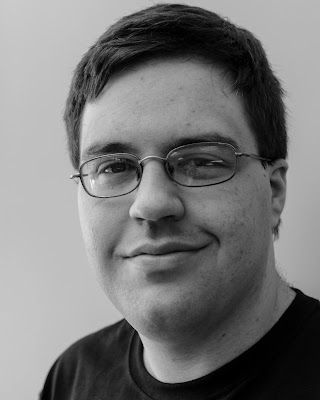
Meet the Author: Matthew Kresal, author of Our Man On The Hill and Sidewise Award winner Moonshot

Matthew Kresal is a writer, critic, and podcaster with many and varying interests. He’s written about and discussed topics as wide-ranging as the BBC’s Doctor Who, Cold War fact and fiction, and the UFO phenomenon. He has appeared on podcasts including Spybrary, Dead Hand Radio, The 20mb Doctor Who Podcast, and The Saucer Life. His prose includes the non-fiction The Silver Archive: Dark Skies from Obverse Press and short fiction including The Aurora Affair in Belanger Books’ A Tribute to H.G. Wells and The Light of a Thousand Suns in in D&T Publishing’s After the Kool-Aid is Gone. He was born, raised, and lives in North Alabama where he never developed a southern accent.


Hi there, and welcome to Altered Instinct! Tell us a little about your most recent book – what is it called, and what is it about? 
It’s called Our Man on the Hill and the elevator pitch is “what if Senator Joe McCarthy, the Cold War’s most infamous hunter of ‘Reds under the bed,’ was really working for the Soviets all along?”

What inspired the story?
I’ve long had an interest in the Cold War and espionage. A few years back my interest was rekindled by a podcast called Spybrary, started by Shane Whaley, which I’ve been lucky enough to be on a few times. Part of that rekindling led to my picking up a non-fiction work called The Haunted Wood. Published in the late nineties when the old Soviet archives were briefly opened up, it contained some fascinating stories of Americans who spied for the Soviets during the 1930s and the World War II years. Reading how it ended, and how little McCarthy really picked up on, was an eye opener. Then I came across somewhere a great quote from President Harry Truman about McCarthy that called the senator “The greatest asset the Kremlin has,” or words to that effect. My mind was off to the races, since “asset” is an intelligence phrase for agent (though I’m certain that’s not what Truman meant when he said it!).  


Without spoilers, what was one of your favourite moments of the story to write? What was it that made you enjoy that section so much? 
There’s a confrontation between McCarthy and then Presidential candidate Eisenhower that I got to write. It was a scene based on a real meeting between the two men where we know how things were said but not what was said, if that makes sense? I had fun fitting that encounter into the narrative, figuring out what McCarthy and his Russian handlers might have come up with that caused Eisenhower to go from about to publicly criticize McCarthy to sharing a stage with him, exchanging handshakes and getting an endorsement.  

What are your favourite genres to read – and what is it about those genres that draws you in? 
To risk sounding pretentious, I don’t know that I read genres specifically. I read what interests me, whether it’s science fiction, historical fiction, non-fiction or whatever. My main thing is, if it’s fiction, to tell me a good story. Non-fiction is different as reading tends to be either for research or just out of general interest. That said, I do seem to read a lot of science fiction and thrillers, as well as history, so I guess you can call those favourties. 

What were some of your favourite books to read as a child? Which were the first books you remember falling in love with?
Growing up in North Alabama, home to NASA’s Marshall Space Flight Center and the Space & Rocket Center museum (the only place in the world with TWO Saturn V’s, even if one is a replica), I was reading books about space from a very young age. I don’t remember specific titles, I wish I did, but I was a voracious reader from a shockingly young age. The first book I remember falling in love with was Walter Lord’s A Night to Remember on the sinking of the Titanic. I read it in third grade around the same time I got bit by the writing bug, and I can’t help but think there’s got to be a connection there.

Are there any particular themes you address in your story? What issues do you explore, overtly or otherwise? 
I don’t know if it’s a theme, as such, but writing alternate history (which Our Man on the Hill fits into, even though it’s a Cold War spy thriller) did allow me to explore some of the real-life history involved. There’s some fascinating stories that came out of the Cold War at large that aren’t as well known as they ought to be. One of the things I hoped to do in writing the novel was to bring some of those stories, and the people behind them, to life. 

What has been your most satisfying moment as a writer so far? What made you punch the air? 
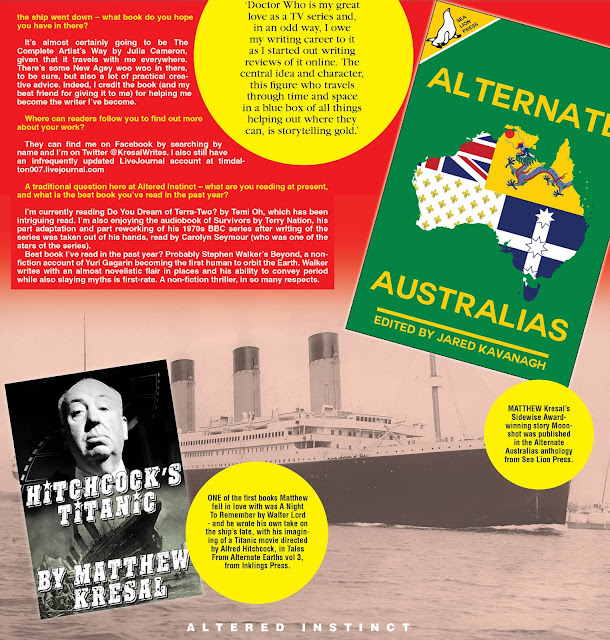
Oh, it’s got to be when my short story Moonshot (featured in Alternate Australias from Sea Lion Press) was nominated and then won the Sidewise Award. As a teenager getting into alternate history, I remember looking at that list in the mid-2000s and being impressed by what I saw. To now be a name on that list still seems surreal, even with having the plaque on my wall. 

Away from books, what are your loves when it comes to TV and movies? 
Doctor Who is my great love as a TV series and, in an odd way, I owe my writing career to it as I started out writing reviews of it online. The central idea and character, this figure who travels through time and space in a blue box of all things helping out where they can, is storytelling gold. Before Doctor Who, The West Wing was my favorite series and it still holds a special place in my heart as a series that helped inspire me to be a writer. As an alternate history fan and lifelong space nerd, I’m also loving Apple TV’s For All Mankind with its vision of a space race that never ended. 
In terms of movies, The Third Man remains my favorite film, being something that works on so many levels. My tastes in movies, like my reading, are pretty eclectic so the list includes the amazing documentary For All Mankind on the Apollo missions, Oliver Stone’s JFK, and the 1995 film of Richard III starring Ian McKellen.


Matthew also appeared in the Tales From Alternate Earths 3 anthology from Inklings Press, with his story about a film version of Titanic made by Alfred Hitchcock.

You get stuck on an island and had only one book packed in your travel bag before the ship went down – what book do you hope you have in there? 
It’s almost certainly going to be The Complete Artist’s Way by Julia Cameron, given that it travels with me everywhere. There’s some New Agey woo woo in there, to be sure, but also a lot of practical creative advice. Indeed, I credit the book (and my best friend for giving it to me) for helping me become the writer I’ve become.

Where can readers follow you to find out more about your work?
They can find me on Facebook by searching by name and I’m on Twitter @KresalWrites. I also still have an infrequently updated LiveJournal account at timdalton007.livejournal.com.

A traditional question here at Altered Instinct – what are you reading at present, and what is the best book you’ve read in the past year?
I’m currently reading Do You Dream of Terra-Two? by Temi Oh, which has been intriguing read. I’m also enjoying the audiobook of Survivors by Terry Nation, his part adaptation and part reworking of his 1970s BBC series after writing of the series was taken out of his hands, read by Carolyn Seymour (who was one of the stars of the series). 
Best book I’ve read in the past year? Probably Stephen Walker’s Beyond, a non-fiction account of Yuri Gagarin becoming the first human to orbit the Earth. Walker writes with an almost novelistic flair in places and his ability to convey period while also slaying myths is first-rate. A non-fiction thriller, in so many respects.


Thursday, 2 September 2021

It's new book day! Tales From Alternate Earths 3 is out now!


Hi all, it's new book day!

Tales From Alternate Earths 3 is out today - in paperback and ebook format - and by golly it's a great collection of stories. 

Am I biased when I say that? Honestly, I don't think so. I have a story in there, sure, but let's leave talking about that until another blog. For starters, just look at that list of authors. 

From the top, there's Alan Smale, whose tale A Clash of Eagles won the Sidewise Award, and whose bibliography is a fantastic list of great reads. His story starts the collection, and... well, I don't want to say too much because part of the joy of the story is piecing together the who, how and where of it all. I do love, however, the viewpoint he tells the story from, that of a real woman of the times he writes about. It's the kind of story that raises big questions, not just about the changes in history, but about how the characters involved are affected, and what it means to them personally. It's splendidly done. 

More great writers! How about Daniel M Bensen, who returns from previous Inklings books - another Sidewise Award winner, for his story Treasure Fleet, in Tales From Alternate Earths 1. Or DJ Butler, a big name in the alternate history field? 

I shouldn't pick favourite stories from the collection, so I absolutely won't hint strongly that my favourite is the fantastic story To Catch A Ripper, by Minoti Vaishnav, who is also a television writer who recently staffed The Equalizer on CBS. (And by golly, I'd love to see her story get the TV treatment too)

Then there's JL Royce, who has been a finalist in the Writers of the Future contest (and his story here is a doozy, mixing noir detective fiction and some shocking post-war history). 

Matthew Kresal was only yesterday named as a finalist for the Sidewise Awards for his previous story Moonshot, and his story in this collection is an intriguing film biography-style take on the making of a much older version of the movie Titanic. 

Add to that returning Inklings names such as Aaron Emmel, Brent A Harris, Rob Edwards, Christopher Edwards, Ricardo Victoria, Jeff Provine and dynamic duo EM Swift-Hook and Jane Jago, and you've got quite the set of authors. 

It's been a pleasure working on this anthology with such great stories. And I hope you might dip your toe to discover them yourself. I won't say too much about each story just yet - as there are twists and turns I don't want to spoil!

I always fall in love with stories in the anthologies we publish - but that's because so many authors give us stories to love. 

You can fall in love yourself by picking up the book at mybook.to/AlternateEarths3. It's available in paperback and in ebook format. 

For reviewers, we also still have review copies available and a full press kit at http://www.alteredinstinct.com/2021/05/press-kit-tales-from-alternate-earths-3.html with graphics and more information. By all means, email theinklingspress@gmail.com to request a review copy, or hit me up on Twitter


Friday, 14 May 2021

PRESS KIT: Tales From Alternate Earths 3

The countdown is on until the launch of Tales From Alternate Earths 3 - and this page will act as a press kit, with more material being added the closer it gets to publication. 

Book link: mybook.to/AlternateEarths3

About the book

Have you ever asked the question “What if…?”

What if things had turned out differently, what if history had taken another turn, what if our world had gone another way? 

That’s the question at the heart of the genre of alternate history – and that powers the stories in the new Inklings Press anthology, Tales From Alternate Earths 3. 

Alternate history has had quite the renaissance in recent years – from TV shows such as The Man in the High Castle, an adaptation of the Philip K Dick novel, to the HBO series Watchmen, and more light-hearted adventures through history such as Timeless or Legends of Tomorrow. Even Disney is getting in on the action with their “What If?” series looking at what might have happened if key moments in the Marvel Cinematic Universe had gone differently. 

That’s the fun of it – there’s so much range in the genre, but all so close to home that it could just be the slightest difference that takes us there.

That difference is usually called the point of departure, the moment when history departs from our own. That can be something huge – an alien ship arrives, say – or it can be a tiny difference. In one of the stories in the new anthology, it hinges on a man having a pair of boots. 

Stories in the book span the world, from Hitchcock directing Titanic to a hunt for Jack The Ripper, from Cold War chicanery to a Roman Empire that never ended, from mythological beings turned real to post-World War Two genetic experiments. It’s a big canvas and it’s great to see what the authors involved bring to the table. And that's not even getting into stories where we wouldn't want to ruin the surprise!

There are stories by Alan Smale, Daniel M Bensen, DJ Butler, Minoti Vaishav, Brent A Harris, JL Royce, Jeff Provine, Ricardo Victoria, Rob Edwards, Matthew Kresal, Aaron Emmel, Christopher Edwards, EM Swift-Hook, Jane Jago and Leo McBride.

The book is out in paperback and ebook format from September 3, and available from Amazon at mybook.to/AlternateEarths3

Graphics

Here, then, are the graphics announcing the first authors to appear in this, the next alternate history anthology from Inklings Press. 


Author biographies

Meet Alan Smale

For his Tale, Alan takes us to an alternate England where the Gunpowder Plot succeeded in all its horror and devastation. Recent analysis has shown that if the 2500kg of gunpowder placed beneath the Houses of Parliament had really gone up, the cataclysm might have been even more devastating than Alan describes. Had Guy Fawkes witnessed what he’d wrought, he might have had a few mixed feelings.

Mary Frith (aka Moll Cutpurse) was a real woman of her times, though her life proceeds rather differently in this newly transformed London. 

Alan’s novella of a Roman invasion of ancient America, “A Clash of Eagles”, won the Sidewise Award, and his associated novels Clash of Eagles, Eagle in Exile, and Eagle and Empire are available from Del Rey (and received a second Sidewise nomination as a trilogy). His Roman baseball collaboration with Rick Wilber, The Wandering Warriors, appeared recently from WordFire Press, and Hot Moon, his alternate-Apollo thriller set entirely on and around the Moon, will be released by CAEZIK SF & Fantasy in 2022. Find him at www.alansmale.com, Facebook/AlanSmale, and Twitter/@AlanSmale. 


Meet Matthew Kresal

Matthew Kresal is a writer, critic, and podcaster with many and varying interests. He’s written about and discussed topics as wide-ranging as the BBC’s Doctor Who, Cold War fact and fiction, and the UFO phenomenon. He has appeared on podcasts including Spybrary, Dead Hand Radio, The 20mb Doctor Who Podcast, and The Saucer Life. His prose includes the non-fiction The Silver Archive: Dark Skies from Obverse Press and short fiction including The Aurora Affair in Belanger Books’ A Tribute to H.G. Wells and The Light of a Thousand Suns in in D&T Publishing’s After the Kool-Aid is Gone. He was born, raised, and lives in North Alabama where he never developed a southern accent.

Matthew’s story so very nearly came true in real life. He was indeed hired by David O. Selznick, having agreed to work on a film about the Titanic disaster, but there our worlds part. Instead, he made Rebecca, and from there went on to make a catalogue of films so famous you know them already. 

You can find Matthew on Twitter, as @KresalWrites. He also has a novel, Our Man On The Hill, available through Sea Lion Press. 


Meet Rob Edwards

Rob Edwards is a British born writer and podcaster, living in Finland.  His podcast, StorycastRob, features readings from his short stories and excerpts from longer work.  His work can also be found in the anthologies published by Inklings Press and Rivenstone Press.

His greatest geek pride is his entry on wookieepedia, the result of writing several Star Wars RPG scenarios back in the day.

He is also a published novelist, with his debut novel The Ascension Machine published by Shadow Dragon Press, and a sequel, The Crossover Paradox, due in March 2022. 

You can find him on Twitter as @StorycastRob, or at his website, storycastrob.co.uk. 


Meet Brent A. Harris

Brent A Harris is a two-time Sidewise Award finalist of alternate history. He writes about dinosaurs, fantasy, the fears of our future and the mistakes of our past. While he considers Southern California home, he currently resides in Naples, Italy. You can learn more by visiting www.BrentAHarris.com. 

Other books by Brent include: A Time of Need: A Dark Eagle Novel (an alternate history of the American Revolution); Alyx: An AI’s Guide to Love and Murder; and Dickens Meets Steampunk in:  A Twist in Time  and A Christmas Twist: A Twist in Time Book II. 

You can find Brent on Twitter at @brentaharris1. 


Meet Minoti Vaishnav

Minoti Vaishnav is a short fiction author who has had five short stories published in print anthologies this year alone. She is also a television writer most recently staffed on The Equalizer on CBS, a former pop star with three albums under her belt, and a documentary television producer who has created shows for Netflix, NatGeo, Travel Channel, and Discovery Channel among other networks. Minoti also has a Masters degree in Creative Writing from Oxford University and is an alumna of the ViacomCBS Writers Mentoring Program. 


Meet Christopher Edwards

Christopher Edwards retired from the oil and gas industry having spent twenty years on several production platforms in the Northern North Sea. Before retiring he also spent time on assignments in Bolivia, Azerbaijan, Iran and the United Arab Emirates. He always enjoyed making up stories for his children and now his grandchildren but was only recently persuaded to start writing. 

This Tale considers the fate of Louis Bonaparte, who in our world was killed in a skirmish with a group of Zulus in 1879 while serving with British forces, his death bringing with it an end to thoughts of a restoration of the House of Bonaparte. Of course, other worlds have other possibilities...

Meet Aaron Emmel

Aaron Emmel is the author of more than fifty published short stories, as well as the Midnight Legion gamebook trilogy, an historical fiction graphic novel and dozens of articles and essays. He grew up in the mountains of New Mexico and graduated from high school in Central America, before cofounding and selling a record label and an online music store. Aaron lives with his wife and two children in Maryland. His story “The Sword of Bone” appeared in the Inklings Press anthology Tales of Magic & Destiny. Find him online at www.aaronemmel.com.

Meet Daniel M. Bensen

Daniel M. Bensen is an American-Bulgarian author of science fiction, alternate history, and fantasy. His work includes the speculative-biology novel Junction and its sequel Interchange, the optimistic post-apocalyptic comic-book First Knife (with Simon Roy). and the Sidewise Award-winning alternate history short story “Treasure Fleet” (in the Tales from Alternate Earths anthology). These stories have been called “clever, entertaining, and thoughtful” (SFBook Reviews) and “at times poignant” (Big Comic Page).

You may also enjoy his other alternate history short story, “The Goose’s Wing” in the Tales from Alternate Earths 2, his novella Petrolea, and his self-published novel Groom of the Tyrannosaur Queen. Daniel is represented by Jennie Goloboy of Donald Maass Literary Agency.

Daniel classifies his work as “speculative aspirational fiction,” which means that he explores other, better places, and the doors that lead to them. He loves learning about real life and extending from it to build plausible and surprising worlds. At odds with themselves and each other, the people in these worlds struggle to turn themselves the right way around, and so generate stories.

Daniel studied biology and history, teaches English as a foreign language, and has survived cancer. After growing up in Chicago, Maine, California, Montana, Japan, and Boston, he followed his then-fiancée to Sofia, Bulgaria, where he has continued to grow up. He now teaches, writes, and resides with his wife, daughters, and in-laws in the Balkan Tower of Matriarchy.

He says: “This story is dedicated to Emil. Life is full of strange and terrifying choices, but that’s better than the alternative. Da rastem, no ne staraem.”

Meet J.L.Royce

J. L. Royce is a published author of science fiction, the macabre, and whatever else strikes him. He lives in the northern reaches of the American Midwest. His work appears in Allegory, Ghostlight, Little  Demon, Love Letters to Poe, Mysterion, parABnormal, Sci Phi, Utopia, Wyldblood, etc. He is a member of HWA and GLAHW. Some of his anthologized stories may be found at: 

amazon.com/author/jlroyce. 

Twitter: @authorJLRoyce     

Facebook: AuthorJLRoyce 

‘Not My Monkey’ was a Finalist in the Q3 2020 Writers of the Future competition.

Unit 731 was a real unit in the Second World War, that undertook lethal human experimentation. A number of researchers were given immunity by the United States secretly in exchange for the data they gathered. 

Meet Leo McBride

Leo McBride is a journalist, editor and fiction writer. He has been published previously in each of the Inklings Press anthologies, along with collections from the Sci-Fi Roundtable, Rhetoric Askew, Starklight Press and elsewhere. He has also self-published his own short story collection Quartet, available on Amazon, and ghost written and edited a number of biographies. You can find more of his work on his blog, www.alteredinstinct.com, on Twitter as @AlteredInstinct and on www.facebook.com/leomcbrideauthor.

This Tale looks at how things might have turned out differently after the Challenger disaster. There was indeed a description after the disaster that NASA was “throwing junk into space” and the Marshall workshop did take place - though there the hopes of a space elevator ended. At least... for now. There are still talks, still discussions, and still technical hurdles to overcome. At least, in our world. 

Meet Ricardo Victoria

Ricardo Victoria is a Mexican writer with a Ph.D. in Design — with emphasis in sustainability — from Loughborough University, and a love of fiction, board games, comic books, and action figures. He lives in Toluca, Mexico with his wife and pets, working works as a full-time lecturer and researcher at the local university. He writes mainly science fantasy.

His first novel, Tempest Blades: The Withered King, was released in August 2019 by Shadow Dragon Press, an imprint of Artemesia Publishing. The sequel, Tempest Blades: Cursed Titans, published in July 2021. He has a number of stories published by Inklings Press, and other indie outlets.

His short story Twilight of the Mesozoic Moon, jointly written with Brent A. Harris, was nominated for a Sidewise Award for short form alternative history.

You can find out more at his website, http://ricardovictoriau.com, or follow him on Twitter, @Winged_Leo. 

Meet Jeff Provine

Jeff Provine is a Professor of English in Oklahoma, USA, tackling topics such as Charles Chaplin, mythology and the history of comic books. He collects local folklore and has created three walking tours of ghost stories in the Oklahoma City metro. His fictional works include YA adventure Dawn on the Infinity, steampunk Celestial Voyages, and alternate history Hellfire. 

Check him out on Twitter @JeffProvine, follow his updates at http://www.facebook.com/AuthorJeffProvine, and read some of his twists on history at http://thisdayinalternatehistory.blogspot.com.

Meet E.M.Swift-Hook 

and Jane Jago

The writing team of E.M.Swift-Hook and Jane Jago has produced a number of books following the characters of Dai and Julia in a world where the Roman empire never faded. 

E.M.Swift-Hook has had a number of different careers, before settling in the North-East of England with family, three dogs, cats and a small flock of rescued chickens. 

You can find her on twitter @emswifthook, and you can also catch up with her Fortune’s Fools series of space opera. 

The term genre-hopper could have been coined to describe Jane Jago and her books, modern-day thrillers sitting side by side with sword and sorcery, wicked dragons, and short stories and verse. You can find her on Twitter at @JaneJago1. 

You can also catch up with both authors at workingtitleblogspot.com.

Meet D.J.Butler

Dave (D.J.) Butler writes adventure stories for all readers. He has been a lawyer, a consultant, and a corporate trainer. His interests include languages, guitar, hanging out with his wife and kids, astronomy, and history.

Sign up to get updates about Dave and his books at: http://davidjohnbutler.com/mailinglist/

The characters in this story are real - Mikhail Lyubimov was a colonel in the KGB, and is also a novelist. 

Oleg Gordievsky is regarded as one of MI6’s greatest triumphs, working as a double agent and playing a crucial role in avoiding nuclear Armageddon. He left the USSR in 1985 in Operation Pimlico. 


Story frontispieces


Ebook cover


Other promotion graphics


Podcast discussion between Brent A Harris and Rob Edwards 


Podcast discussion featuring several of the authors 


Also available at this link and all are welcome to embed media: https://youtu.be/-9bKz9f8NEw

Podcast discussion featuring several of the authors 


Also available at this link and all are welcome to embed media: https://www.youtube.com/watch?v=MLuWthhLeuc